


 Contact Us

NEW DATA THIS MONTH: Q1 Retail Sales Report
MUSIC TRADES DATA SUBSCRIPTIONS

Sign Up For Annual Data Packages and Access 100+ Years of Back Issues
New data subscription options deliver a year's worth of Music Trades reports bundled at a cost-effective rate. Subscribe to get the newest reports the moment they're released.
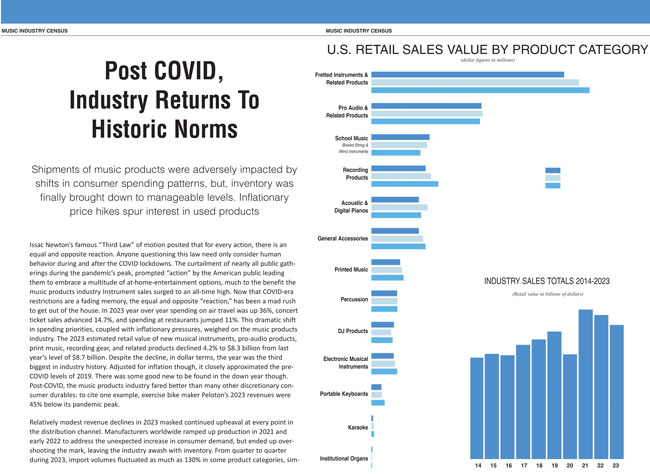
JUST RELEASED 2024 Industry Census Post COVID, Industry Sales Return To Historic Norms
Shipments of music products were adversely impacted by shifts in consumer spending patterns, but inventory was finally brought down to manageable levels
Relatively modest revenue declines in 2023 masked continued upheaval at every point in the distribution channel. Manufacturers worldwide ramped up production in 2021 and early 2022 to address the unexpected increase in consumer demand, but ended up overshooting the mark, leaving the industry awash with inventory. From quarter to quarter during 2023, import volumes fluctuated as much as 130% in some product categories, simply because there wasn’t sufficient warehouse space to accommodate additional shipments. The industry-wide glut .......
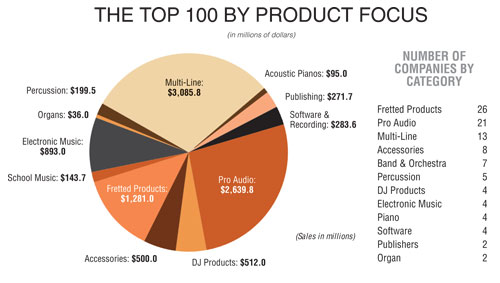
JUST RELEASED 2024 Top 100 North American Manufacturer Sales Ranking
Sales for top companies decline reflecting consumers’ post-COVID shift in spending priorities
Aggregate revenues for the 100 largest music products suppliers serving North America declined in 2023 reflecting consumers’ post-COVID shift in spending priorities, from discretionary hard goods to out-of-home experiences and services. Rising inflation, widespread economic uncertainty, and a comparative dearth of product innovation also contributed to the decline. Employment levels for the group were essentially unchanged at 23,800. The Top 100 is a diverse roster including a variety different of corporate structures and a dizzying array of products--everything from…..
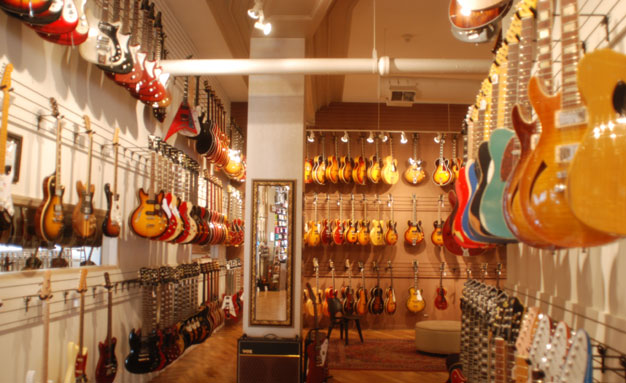 JUST RELEASED 1st Quarter Retail Sales Report for USA
 JUST RELEASED
 Dealers are optimistic that lower inflation and interest rates, low unemployment and the beginnings of a housing market turn will lead to a sales rebound.
Nationwide economic trends continue to impact sales of musical instruments and audio gear as evidenced by this first quarter retail sales report that reveals a sales decline for the three-month period ending March 31, 2024. Retailers across the country indicate that inflation and the cost of family basics have left customers tapped out.......
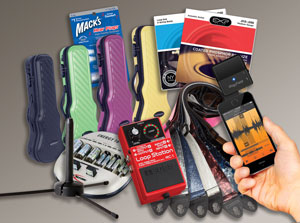
The 2023 Market Report For Musical Instrument & Audio Accessories
New report includes sales data for more than two dozen different accessory products.
The accessory category, which includes a wide variety of small goods that complement all musical instruments and audio products, enjoyed strong results in 2022. The estimated retail value of Accessory products shipped to the specialized m.i. distribution channel and sold direct to consumer by manufacturers advanced to a record level from the previous year. In this detailed report… ...

Thalia Capos Retools For Medical Gear
With experience in the medical device field, founder Chris Bradley puts his shop into service for pandemic fight.
Bay Area accessories maker Thalia Capos is retooling to build a simple but potentially life-saving device to help medical teams caring for critical COVID-19 patients. In addition...
Complete Music Industry Sales Report: 2024 Edition
Find detailed sales statistics on all music and sound equipment: 55 different categories, average unit prices, sales by price point, unit volume, retail and wholesale margins, year-to-date, and 10-year historical data.

The State of the Online Retail Marketplace: 2023 Edition
The top 50 online music retailers worldwide, ranked by revenues – plus contact information, base country, employee count, products carried, and year-to-year trends.
Three years of data included.
COMPLETE DATA
 TOP 100 SUPPLIERS REPORT

The 100 leading U.S. music companies ranked by the most recent full-year revenues. Also included: employee count and chief executive for each ranked company, plus complete analysis. Excel version includes company contact information and ten years of data.
 TOP 200 RETAILERS REPORT

The 200 leading U.S. music retailers ranked by the most recent full-year revenues. Also included: employee and store counts, productivity statistics, products carried, and year-to-year trends – plus complete analysis. Excel version includes company contact information and five years of data.
 GLOBAL 225 REPORT

This two-part report includes: 1) A list of the leading 225 music companies around the world, ranked by the most recent full year revenues – plus employee count, CEO, base country, and web address for each. 2) Basic sales and demographic data on 47 countries where music products are sold. Includes complete analysis. Excel version includes two years of country data and five years of company data.
 MUSIC INDUSTRY CENSUS REPORT

Comprehensive U.S. data on 55 product categories across the music products industry. Find ten years of figures showing sales by unit volume, wholesale and retail value, average unit price, and year-to-year trends. A complete analysis is included.
 BUY ALL FOUR
 BUY ALL FOUR
The best price on Music Trades' four most popular reports: the Music Industry Census, Top 100 Suppliers Report, Top 200 Retailers Report, and Top 225 Global Report
 INTERNATIONAL DEALER SALES REPORT

Find sales and company data – including revenues plus employee and location counts – for 328 leading retailers in 59 countries where music products are sold. Includes complete analysis and company profiles on standout retailers around the world. Excel version includes contact information and market data by country.
 QUARTERLY RETAIL SALES REPORT

A snapshot of the latest U.S. sales in 15 music products categories, plus regional data, analysis, and trends going back eight quarters.

IMPORT TRACKER
The most recent quarter's import figures for key music products categories by product type, price point, and country of origin, plus year-to-year trends and analysis.

THE STATE OF THE ONLINE RETAIL MARKETPLACE
The top 50 online music retailers worldwide, ranked by revenues – plus contact information, base country, employee count, products carried, and year-to-year trends. Three years of data included.

2023 ACCESSORY MARKET ANALYSIS
This all-new report presents three years of data on U.S. retail and wholesale volumes for all key musical instrument and audio accessories that collectively accounted for over $1.2 billion in retail sales in 2022.


The leading SOURCE OF DATA & ANALYSIS SINCE 1890
© 2018 Music Trades Corporation. All Rights Reserved