


 Contact Us

NEW DATA THIS MONTH: Q1 Retail Sales Report
COMPANIES TO WATCH
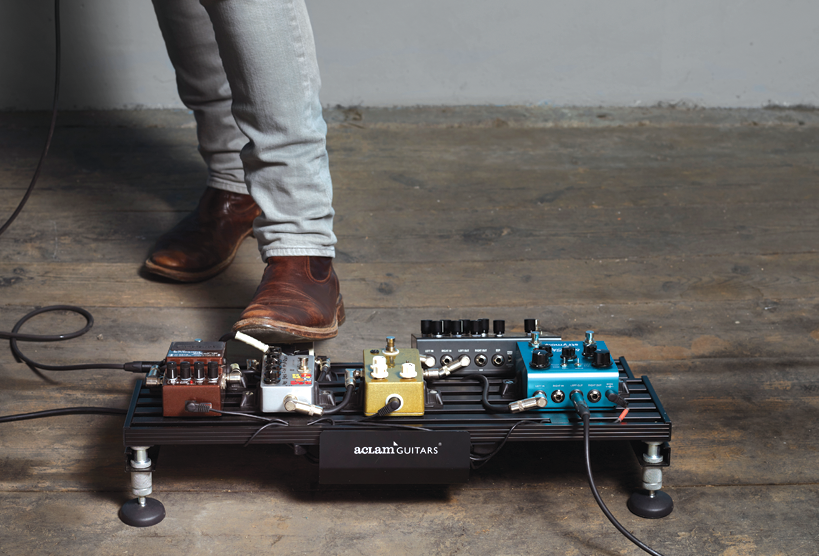 |
| Aclam’s Smart Track pedalboards feature a patented design for locking pedals into place without adhesives. |
ACLAM GUITARS
Web-savvy Spanish accessories maker expands into full-fledged guitars.
BARCELONA WAS WHERE Jordi Canivell started Aclam Guitars ten years ago, though its other home has always been the World Wide Web. A man of many interests—including music, photography, and motorcycles—Canivell had just opened a gallery and club to showcase his collections when he decided he needed a creative way to mount his guitars on the walls. After enlisting his brother-in-law, David Mañosa Ripoll, for design help, the two emerged with Aclam Guitars’ first product: the Floating Guitar Support, a patented display device that mounts the instrument sleekly to the wall, invisibly supported and apparently defying gravity. Later, the startup would branch out into a range of modular pedal boards, effects pedals, and—just recently—an original guitar line. First, though, Canivell and his team had to crack the market, and they’d do it in their own way. Approaching the marketplace as digital natives, they went straight to the web to connect directly with customers worldwide, even going out of their way to target markets where traditional distribution was spotty or hard to break into. Between direct sales and a handpicked network of dealers, Aclam products are now sold in 43 countries—from Western Europe and North America to Japan, China, much of Eastern Europe, and points around the Middle East and Southeast Asia.
“Being an unknown company, from a country with a long tradition of classical guitar lutherie but without much tradition in accessories manufacturing, forced us to adapt to new sales channels,” says Canivell. “Since the beginning, we have shaped our efforts to adapt to the changing nature of the market and the interaction customers expect from a brand: reaching out to them quickly and connecting with them closely. Technology could well be the most important link between our company and our customers.”
Based in Barcelona’s Eixample district, home to both a tech sector presence and a variety of artisan workshops, Aclam Guitars has often drawn influence from its surroundings. A polished aesthetic typical of local design showed up in Aclam’s first ever product, the Floating Guitar Support. From there, Canivell and his team would expand into other categories; first a range of modular pedalboards based on their patented Smart Track concept, a system of grooves and fasteners that allows pedals to slide and lock into place without the use of adhesives. With a custom pedalboard building tool offered through Aclam’s website, customers can now design their own pedalboards with options for size, cable routing configuration, and fastening method—either Smart Track, a more traditional Velcro-based design, or a hybrid.
In its next venture, Aclam emerged just over a year ago with a pair of original guitar effects: the Cinnamon Drive and Dr. Robert overdrive pedals, both with enclosures configured for the Smart Track system. In the Cinnamon Drive, Aclam designers created a versatile dual overdrive pedal spanning tones from light overdrive to highly saturated distortion. Pushed to the max, it evokes ’60s and ’70s tube amp tones in the style of Clapton, Page, and Hendrix. In the Dr. Robert, Aclam took on a more specific project, replicating as closely as possible the sound of the Vox UL730 amplifier made legendary by the Beatles on Revolver and Sgt. Pepper’s Lonely Hearts Club Band. A meticulous study of old schematics and original components laid the foundation for this “amp in a box”—and artwork by Klaus Voormann, the artist behind the Revolver album, tops off the enclosure.
“Besides offering long-lasting, reliable product and not getting carried away by low pricing strategies, Aclam always offers product features that aren’t on the market yet,” says Aclam Guitars’ Marta Hereu. “There has to be something innovative and different from the existing options—otherwise we won’t develop it.”
Would Aclam’s approach translate to a full-fledged guitar? In their latest project, Canivell and his team decided to find out, crafting an original line of electrics with a retro aesthetic, high-end artisan finishing, and a range of patented features. Most uniquely, they’ve been described as a “hybrid” design, approaching the tones of an acoustic instrument in a solid-body electric. Due to ship imminently, they’re available for pre-order on the Aclam website—which also features a selection of guitars by the boutique builder Rudy Pensa, founder of Rudy’s Music in New York. Aclam distributes his Pensa Custom Guitars line in Europe. As for Aclam’s own guitar line, plans call for a strategy in line with what’s worked for its earlier products, connecting directly with customers via web sales and social media while opening up select dealers with experience in boutique goods—“where the experience becomes more important than just dealing with customers quickly,” Aclam Guitars’ Joel Gelabert explains.
“It’s our goal to develop products with a strong story behind them, and with those touches that set them apart from any existing option,” he adds. “All the technology and the artisan finishing reflects our motto—‘Feel, Think, Play’—and our desire to keep doing what we love to do.”
www.aclamguitars.com
 |
 |
 TO ALL FEATURES
The leading SOURCE OF DATA & ANALYSIS SINCE 1890
© 2018 Music Trades Corporation. All Rights Reserved